
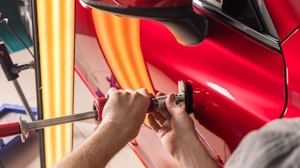
 Dents on a car’s body are, unfortunately, quite common. They typically result from minor accidents or random impacts during parking. The size of the damage can range from minor to significant. However, this problem can be easily resolved: the PDR method can repair even large dents up to 20-30 inches in size while preserving the original paint finish.
PDR Technology
Paintless Dent Removal (PDR) Technology has revolutionized the automotive body repair industry by offering a cost-effective and eco-friendly alternative to traditional methods. Utilizing specialized PDR techniques, skilled PDR technicians meticulously massage dents from the inside out, restoring a vehicle’s surface without compromising its original paint. This approach eliminates the need for fillers or repainting, making it ideal for addressing minor dents from hail, door dings, or other impacts that cause cracking or chipping. To master this precise craft, professionals undergo rigorous PDR training, learning to manipulate tools and assess damage with accuracy. By preserving factory finishes and reducing repair times, paintless dent removal continues to gain popularity among car owners and repair shops alike.
PDR for Large Dents — An Effective Solution
Large dents used to automatically mean repainting, fillers, and traditional body shop repairs, but modern Paintless Dent Repair (PDR) has expanded far beyond minor door dings. Today’s professional technicians can repair surprisingly large dents when the metal has not been excessively stretched, and the paint remains intact.
Repairing a significant dent using PDR takes a combination of specialized tools, controlled pressure, and precise metal manipulation. The technician gradually massages the dent from behind the panel or uses adhesive-pulling techniques from the outside, rather than grinding or repainting it. With the right approach, even dents the size of a basketball can be successfully restored to near-factory condition.
The key advantage of PDR for larger dents is preservation: preserving the original paint, preserving the resale value, and preserving the panel’s structural integrity. Unlike traditional repairs, there’s no introduction of fillers or colour-matching issues. This is especially important for newer vehicles with high-quality OEM paint that is more durable and flexible than aftermarket refinishes.
However, not every significant dent qualifies. The determining factors include depth, paint condition, accessibility, and metal tension. A substantial dent with smooth, rounded edges is typically an excellent candidate, while a sharp crease or dent on a double-reinforced area may require a hybrid repair.
For many Alberta drivers dealing with parking mishaps, wind-blown objects, or minor collisions, large-dent PDR is not only possible but often the best solution. When evaluated by a skilled technician, PDR can restore large dents while maintaining your vehicle’s original finish, at a fraction of the cost and time of traditional body shop repairs.
Types of Dents That Are Generally Repairable with PDR
| Dent Type | Description | PDR Repairability | Notes |
| Round Dents | Hailstones, ball impacts, falling acorns | Excellent | Clean, rounded dents are ideal for Paintless Dent Removal. |
| Door Dings / Parking Lot Dents | Caused by doors, carts, and minor impacts | Excellent | Very common, typically shallow. |
| Crease Dents | Long, narrow dents from sliding objects | Moderate | Repairable if the crease is not too sharp. |
| Body-line / Edge Dents | On swage lines or near edges | Moderate-Challenging | Skilled technicians can repair many, but not all. |
| Multi-point / Compound Dents | Hailstorm clusters | Excellent-Good | Great for hail repair when paint is intact. |
| Minor Collision Dents | Low-speed impacts | Good if the paint is undamaged | Depends on the depth and the stretched metal. |
Key Factors That Make a Dent Repairable with PDR
| Factor | Why It Matters | Best Conditions for Repair |
| Shape of the Dent | Smooth, round impacts allow metal to “relax” back | Round + shallow = ideal |
| Size | Large dents require intact paint + non-stretched metal | Broad dents with soft edges |
| Location / Access | Panels with accessible back sides are easier | Doors, hoods, roofs |
| Paint Condition | PDR requires flexible, undamaged paint | No chips, cracks, or fractures |
| Metal Condition / Flexibility | Some metals resist reshaping | High-strength steel & aluminum need expert PDR |
PDR Limitations: When PDR Is Not the Best Option
| Limitation | Why It Prevents PDR | Possible Alternatives |
| Paint Damage | Cracked paint means the surface can’t flex | Traditional body repair |
| Severe Creases or Folds | Metal has been sharply stretched | Body filler + repaint |
| Stretched Metal | Impact distorts the panel beyond its natural shape | Combination repair |
| Access Issues | Inner bracing blocks tools | Glue-pulling or partial disassembly |
| Non-Metal Panels | Plastic/fibreglass cannot be reshaped | Replacement, traditional repair, or Scratch Repair |
Dented: Professional Dent Removal
At Dented, our technicians specialize exclusively in Paintless Dent Repair, which allows us to deliver exceptional results with every repair. If your vehicle has sustained hail damage, door dings, or minor-impact dents, our team has the tools, training, and experience to restore your vehicle’s panels with precision and care.
We use reliable precision steel tools and updated glue-pull methods to gently return the metal to its original form without touching your factory paint. This way helps protect your vehicle’s value and delivers a clean, seamless finish that traditional body shops usually can’t achieve without repainting.
If you’re not sure whether your dent can be fixed with PDR, we’ll be happy to have a look and give you a quick, honest assessment. Just upload a few photos and details, and our team will walk you through the best repair options.
For a fast estimate, visit:
Absolutely, PDR works on aluminum, but it requires more skill because aluminum is less flexible than steel. A trained technician can achieve excellent results, but the repair process may take longer.
Yes. Dents with cracked paint, sharply folded metal, severe creases, or structural distortion cannot be fully repaired using PDR alone. Non-metal panels and extremely stretched metal are also not suitable candidates.
Depth matters more than width. Even a small dent can be too deep if the metal has been sharply impacted. Usually it is easy to repair small to moderate-depth dents. Very deep dents may indicate stretched metal, which can limit PDR effectiveness.
PDR technicians use a combination of precision tools and carefully applied pressure to slowly massage the dented metal back to its original shape. It starts with the assessment of the backside of the panel or using specialized glue-pull techniques on the exterior surface. We don’t use any sanding or fillers. Instead, our technician works stage-by-stage, restoring the metal’s natural contours while preserving the original factory paint. This method maintains your car’s value, it will be almost impossible to notice that there was a scratch.
No, PDR is specifically designed to avoid damaging paint. However, if the paint is already cracked, aged, or previously repainted, there is a higher risk of cracking during the repair. OEM factory paint is flexible and generally very safe for PDR.
Yes, PDR can repair large dents as long as the paint is still intact and the metal hasn’t been overly stretched. Large, smooth dents (such as those caused by a knee, shoulder, or minor collision) often have excellent repair outcomes. Sharp or deeply creased dents may require a hybrid repair.