
What is paintless dent repair?
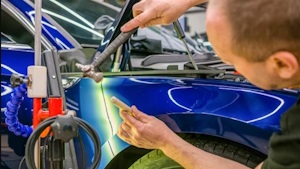 Paintless Dent Repair (PDR) is a modern, non-invasive method of removing dents without sanding, fillers, or repainting. If you’re searching for Fix a Car Dent with PDR, what is PDR, or what does PDR stand for? The answer is simple: PDR stands for Paintless Dent Repair – a technique that restores the metal surface to its original shape using controlled pressure and specialized tools.
So, what are Paintless Dent Repair (PDR) techniques?
They include metal reshaping from behind the panel, glue pulling, and fine-tuning minor imperfections using reflective lighting systems.
What PDR Really Means
| Aspect | Explanation |
| PDR meaning | Paintless Dent Repair – a method that fixes dents without repainting. |
| What does PDR stand for | Paintless Dent Repair. |
| Core method | Metal is gently moved back into place using precise pushing/pulling tools. |
| Goal | Restore the panel while preserving the original paint. |
| Used for | Hail dents, door dings, creases, and minor collision dents. |
Benefits of PDR vs Traditional Body Repair
PDR offers several advantages over filler-and-repaint body shop techniques. These benefits include cost savings, time efficiency, and the preservation of your vehicle’s factory finish. The method is also eco-friendly, making it ideal for modern repairs.
Below are the essential PDR Benefits and how they compare to traditional repairs. This section also highlights PDR effectiveness based on the real results we see daily.
Key Advantages of PDR
- You will save the cost: No filler, primer, or repainting required.
- Preserves original paint: Factory finish stays untouched.
- Faster turnaround: Many repairs take only 1-3 hours.
- Eco-friendly: No chemicals, no paint fumes, no waste.
- Higher resale value: Original paint is always worth more, which is why Paintless Dent Repair is better.
PDR vs Repaint + Filler
| Feature | PDR | Repaint + Filler |
| Average cost | $150-$450 per dent | $400-$1,200 per panel |
| Repair time | 1-3 hours | 2-5 days |
| Paint match issues | None (original paint stays) | Possible mismatches over time |
| Resale value impact | High – factory finish preserved | Lower – repaint is visible in history |
| Eco impact | Zero chemicals | Uses fillers, primers, and paint |
| PDR effectiveness | Excellent for hail damage and minor dents | Required only for paint-damaged or severe dents |
Time & Cost Savings (Typical Example)
| Repair Type | Estimated Time | Estimated Cost |
| PDR | 2 hours | $250 |
| Traditional Repair | 3–5 days | $900 |
Average savings: up to 70% in time and up to 60% in cost.
PDR Risks, Drawbacks, and Common Issues
Although PDR is highly effective, it’s important to understand possible limitations and risks. Experienced technicians know how to avoid these issues, but transparency helps customers make an informed choice.
Below, we cover the most common PDR Risks and PDR Issues.
Common Concerns
- High spots (over-pushing): Happens when metal is pushed too far outward. Skilled technicians avoid this through precise pressure control.
- Remaining damage: Some deep dents may not achieve “perfect” results, especially when the metal is overstretched. And car owners may decide to leave the scratch – but this is not where you should save. Leaving damage untreated can lead to bigger problems over time (see Why You Should Repair Dents for a full explanation of the long-term risks).
- Perceived dent reappearance: If the metal was previously stressed, shadows can make it look like the dent returned – even though the surface is flush.
- Paint damage complications: If paint is chipped or cracked, PDR cannot fully restore appearance without additional touch-up or repainting.
Common PDR Risks and How They’re Managed
| PDR Risks / Issues | Explanation | How We Prevent or Fix It |
| High spots | Over-pushing causes raised metal | Controlled micro-pressure and LED light systems |
| Imperfect results | Stretched metal may not return 100% | Informing clients during assessment + blending techniques |
| Recurring dent illusion | Shadows on previously weakened metal | Cross-checking with multiple light sources |
| Paint damage (chips/cracks) | PDR cannot restore paint | Touch-ups or repainting when necessary |
Questions:
PDR doesn’t work if the paint is cracked, the dent is extremely deep, the metal is overstretched, or the panel edge is crushed. Limited access behind the panel can also make PDR unsuitable. In these cases, a combination repair or repainting may be required.
Yes. PDR is the preferred method for hail damage repairs because hail dents rarely damage the paint. It removes many dents efficiently while keeping the vehicle’s original finish and value.
Small dents usually take 30 minutes to 2 hours. Medium dents require 1–3 hours, and hail damage may take 1–3 days, depending on severity. It is much faster than traditional repainting.
Yes, PDR is completely safe for factory paint. Modern coatings can flex without cracking, and the process uses no sanding, chemicals, or heat. As long as the paint isn’t already damaged, PDR is one of the safest repair methods.
During the paintless dent repair process, technicians apply controlled pressure from behind the panel or use glue pulling from the outside to move the metal back into place. LED lights highlight the high and low spots, allowing precise adjustments while protecting the factory finish.
PDR works without repainting when the paint is flexible and undamaged. It’s ideal for hail dents, door dings, and soft impacts. If the paint is cracked or chipped, the dent can be repaired, but paintwork may still be needed afterward.
Paintless Dent Repair is fast, cost-effective, and preserves your vehicle’s factory paint. It requires no sanding or chemicals, keeps resale value higher, and works well for everyday dents, door dings, and hail damage. It’s one of the cleanest and most efficient modern repair methods.
Small dents usually can be fixed for $150-$250, medium dents from $250–$400, and complex dents or hail-damaged panels can range higher depending on the number of impacts. PDR is still significantly more affordable than traditional body repair because it requires fewer materials and less time. For multiple dents, customers often receive reduced per-dent pricing. For detailed pricing breakdowns, you can explore our dent repair cost guide.
If you’d like to understand your repair options or get a quick quote, you can upload photos and request a professional assessment here: https://dented.ca/request-an-estimate/